Startup Equity Instruments
Explained Like You're Smart, Not a Lawyer
For US-based B2B founders (Angel → Series A): the basic equity building blocks every startup uses—and why mistakes here quietly explode later.
TL;DR
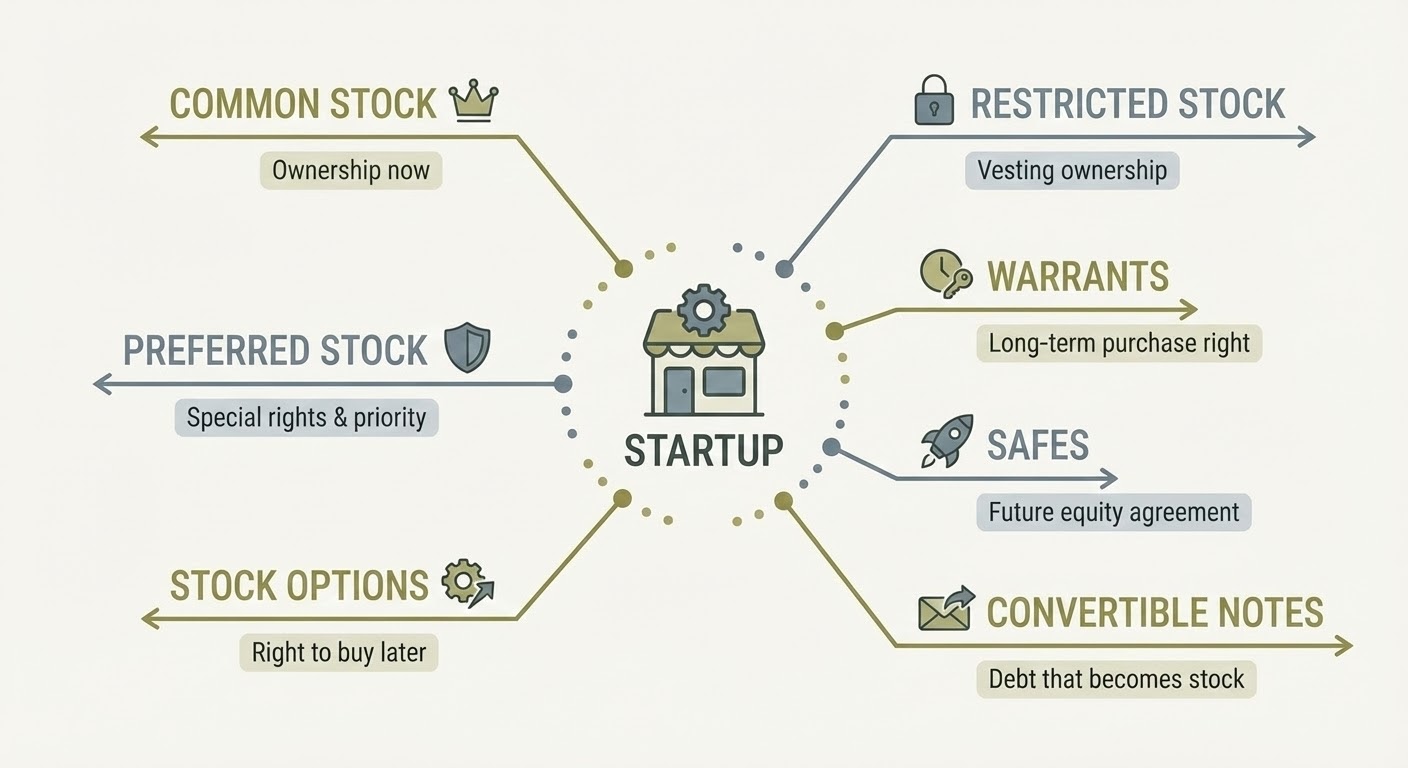
Startups issue equity in several forms: stock, options, restricted stock, warrants, and convertible securities like SAFEs and notes.
Each instrument behaves differently for ownership, control, taxes, and cap tables.
Most founder mistakes come from mixing these up or issuing them without the required approvals, documents, or valuations.
What Is Equity?
Shares / Stock
Definition: Shares (or "stock") represent ownership in a company.
"Stockholder" and "shareholder" mean the same thing
Delaware corporations (most startups) use "stockholder"
California often uses "shareholder"
Different classes of stock (e.g., Common Stock, Series A Preferred) have different rights, preferences, and privileges
Those differences live in the certificate of incorporation also known as the charter or articles of incorporation
Why this matters: Not all stock is created equal. Investors don't buy "ownership vibes"—they buy specific legal rights.
Stock Options
Definition: A stock option is the right to buy stock later at a fixed price.
Options are not stock
Option holders cannot vote and do not receive dividends
Stock only exists once the option is exercised
Exercising = paying the exercise price to buy shares
Why this matters: Founders regularly promise "equity" when they're actually granting nothing yet.
Value: Par Value vs Fair Market Value (FMV)
Par Value
The lowest legal price at which shares can be issued
Mostly a legal minimum, not economic reality
Fair Market Value (FMV)
The current value of one share.
For Options:
FMV must come from an independent 409A valuation
The 409A valuation must be less than one year old to comply with Section 409A of the tax code
Major events (like fundraising) can invalidate it
For Stock:
A 409A valuation is highly recommended to determine FMV
Why this matters: Incorrect FMV = tax problems for your team and red flags for investors.
Cap Table Basics
Definition: A capitalization table (cap table) records who owns what.
Fully Diluted Cap Table
Includes:
Issued stock
Options
Warrants
SAFEs
Convertible notes
Why this matters: Investors price risk using the fully diluted picture, not the "clean" version founders prefer.
Stock Plans & Equity Incentives
Definition: A Stock Plan (Equity Incentive Plan) allows a company to issue restricted stock or options to employees in compliance with tax and security laws.
Key requirements
Must comply with tax rules (e.g., Rule 701)
Reserves a fixed pool of shares
Must be approved by stockholders within one year of approval by the board
Why this matters: Issuing options outside a plan is one of the most common startup errors—and one of the most expensive to fix.
Vesting (Where Confusion Peaks)
What Vesting Means
For Stock:
The purchaser owns the stock immediately
The company can repurchase unvested shares at cost if the person leaves
For Options:
Vesting controls when the option can be exercised
No vesting = no exercisable option (unless the option is granted as an early exercise option)
Common Terms
Cliff: period where nothing vests
Vesting Schedule: timeline of vesting
Standard schedule: 4 years, 1-year cliff
Vesting commencement date: when vesting starts (must be before the grant date)
Exercising Options
Can exercise vested options while providing services
After leaving, typically 3 months to exercise
Unexercised options are canceled
Most options expire after 10 years
Why this matters: Miss an exercise window and equity disappears permanently.
Restricted Stock
Definition: Stock issued upfront with restrictions until vesting.
Key Features
Immediate ownership and voting rights
Company can repurchase unvested shares if the person leaves
Vested shares are fully owned
The issuer and holder of the stock may be subject to additional tax liabilities if the stock is issued below FMV
Why this matters: Restricted stock behaves very differently from options—especially on departure.
Warrants
Definition: Warrants are rights to buy stock later, similar to options.
Differences
Usually issued outside a stock plan
Often granted to entities (not employees)
Common in commercial agreements
Why this matters: Warrants still have the potential to dilute ownership and must be tracked.
Convertible Securities
SAFEs
Money now, equity later
Convert during a future financing
No stock until conversion
Convertible Notes
Debt that may convert into equity
Have repayment mechanics
Cap Table Treatment
Tracked
Not counted as issued stock until conversion
Why this matters: Ignoring convertibles makes your cap table fictional.
Required Compliance Steps (Non-Optional)
Equity can only be issued if all of the following are true:
Board Approval
Required before issuance
Grant date = board consent date
Share Availability
Stock: enough authorized shares
Options: enough plan-reserved shares
Options Require
An option plan
A valid 409A valuation (< 1 year old)
Signed option agreement
Signed exercise notice (when exercised)
Stock Requires
Board consent
Signed stock purchase agreement
Purchase price paid
Some states require securities registrations. This affects compliance—but not the cap table.
Why this matters: Unsigned, unpaid, or unapproved equity does not legally exist.
FAQ
Q: Are options equity?
A: No. They are a right to buy equity later.
Q: Can I issue equity without board approval?
A: No.
Q: Does unpaid stock count?
A: No.
Q: Do SAFEs dilute ownership today?
A: Economically yes, legally no—until conversion.
Bottom Line
Equity instruments look similar but behave very differently.
Most founder horror stories start with "we thought this was fine."
What To Do If You're Busy (or Normal)
7 days free on any plan. No charge until you’re ready.
Get Automated Legal with Aegis
Subscribe to Aegis to build your cap table automatically — see your ownership breakdown, equity classes, and investment history organized from your documents.
We're lawyers, remember? Please read this important note:
Story LLP is a law firm, and Story's lawyers built Aegis to deliver better, standard legal services at scale so founders can choose between top-tier specialized lawyers and standardized process automations that replicate those lawyers according to their needs and budget. By definition, a standardized process may not be perfect for you. Please review our Policies page to better understand the difference, as well as how we use AI and how we manage conflicts, privilege, etc.
As a law firm, we must screen clients for conflicts of interest, and we treat all correspondence with clients seeking legal advice as privileged and confidential to the maximum extent possible in consideration of any conflicts. However, Story's law firm or our Attorney Allies do not represent you or your company as your lawyer, do not have an attorney-client relationship with you or your company, and do not provide you with legal advice absent a formal Engagement Letter signed between you and the Story LLP law firm. Please don't confuse the free knowledge we offer on this site with legal advice for you.