Registering Investment Securities for Exemption
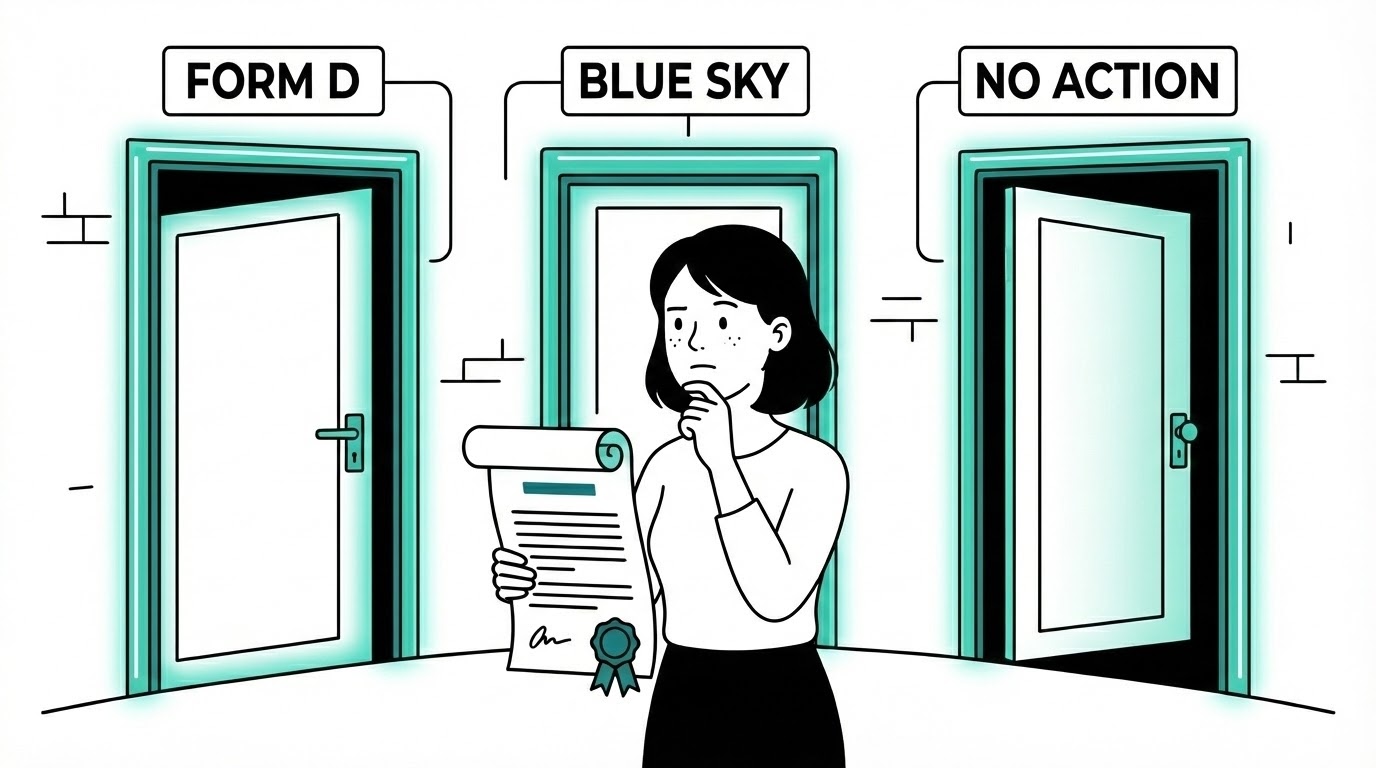
Form D vs Blue Sky vs No Action
For US-based B2B startups (Angel → Series A), understanding your options for securities exemptions is essential to compliant fundraising.
TL;DR (Key Takeaways)
Your investment instruments (SAFEs, convertible notes, Series A preferred stock financings, etc.) are securities. That means you either register them, use an exemption, or meet an exclusion from registration.
Your basic options to obtain an exemption from most investment transactions are: 1) filing a federal Form D, 2) filing only state Blue Sky filings, or 3) filing nothing.
Pretty much every qualified lawyer believes that at least Blue Sky filings are required to receive investment compliantly, but not every lawyer advises clients to spend the time and money to file them.
If you do nothing, you're either relying on an argument you fit within an exemption without further action, or choosing to assume the risk and deal with it later.
Basic Legalese Translation
You register your investment securities (any right to hold or acquire shares in your entity) in order to avail yourself of an exemption from more substantial requirements that are normally applicable to offering and selling securities in or from the United States. See below for more detail about why you need a securities exemption.
Defining Legalese Terms
Investment securities
Any right to hold or acquire shares in your entity.
Form D
A document that the SEC requires a company to file when it issues securities in a private placement under Regulation D.
Blue Sky filings
State-level filings to exempt your securities from state registrations.
No action
Filing nothing.
Your 3 Basic Options
Option 1: Form D (Federal + State)
If your investment is particularly contentious, involves international investors, is a priced round, or if you simply prefer to minimize risk at an increased cost, we normally suggest you file a Form D at the federal and state level to register your investment securities.
Option 2: Blue Sky only (State)
If your investment is not contentious, done with US investors only, on SAFEs only, it is still a security that must be registered or exempt.
Some lawyers may suggest filing at only the state level only (Blue Sky filings) to exempt your securities from state registrations and may also think a Form D is not necessary under these circumstances.
Note also that not all states require filings under all circumstances.
Option 3: No Action (File nothing)
If you make no filings, it comes with risks. Learn more about these below. Usually this causes most problems if your company grows and takes further equity investment, or gets an acquisition offer.
What's the basic background about this?
Note that all investments in your company (such as SAFEs, a Series A Equity Financing, or Convertible Debt) are securities. They are subject to securities regulations at both the state and federal level. This means you technically either need to register the securities, avail yourself of an alternative to registration, or meet an exclusion from registration to comply with the law.
Cost Expectations
Form D — typical cost range: ~$1,000–$4,000
You should expect to spend ~$1,000-$4,000 dollars to file a Form D and related state filings. Here's why, and what they'll include:
You'll have hourly fees for a paralegal and a supervising attorney to prepare and submit the forms
You'll pay filing fees in most states, generally ranging from $50-$300
If your investment was more than 30 days ago, you may also have to pay late filing penalties that can be $2000+ in a single state
In some states, you can file the same Form D you did at the federal level; some states require their own specific forms, and some states require nothing
You'll need to share personal details about yourself and info about the company to populate these forms
If you've never filed something with the SEC before, there will be an additional process of registering to get a "CIK" (Central Index Key), and applying for the CIK requires your notarized signature on some stuff
The more states that require filings your investors reside in, the more filing, time, and filing fees you will pay to get this done
Additional details about Form D, why to file it, and why you may not have to below.
Blue Sky — typical cost range: ~$1,000–$2,000
Most companies spend ~$1,000-$2,000 dollars to make Blue Sky filings, but the exact amount depends on how many (and which) states your investors are located in. Here's why:
If you choose to make Blue Sky filings, you'll have hourly fees for a paralegal and a supervising attorney to prepare and submit the forms for each state that requires a filing
You'll pay filing fees in most states, generally ranging from ~$50-$300, for each filing
If your investment was more than 30 days ago, you may also have to pay late filing penalties that can be $2000+ in a single state
You'll need to share personal details about yourself and info about the company
Key difference: Form D includes federal SEC filing plus state filings, while Blue Sky covers state filings only. Form D is typically recommended for priced rounds and international investors.
Quick Comparison
| Option | Typical Cost | Best For | Filing Level |
|---|---|---|---|
| Form D (Federal + State) | ~$1,000–$4,000 | Priced rounds, international investors, contentious investments, risk minimization | Federal (SEC) + State |
| Blue Sky (State Only) | ~$1,000–$2,000 | US-only investors, SAFEs, non-contentious investments | State only |
| No Action | $0 (upfront) | Assuming risk, dealing with it later | None |
What Are the Risks of Filing Nothing?
If you make no filings: you're either relying on an argument that you fit within an exemption without further action, or choosing to assume the risk and deal with it later.
This usually causes the most problems if your company grows and takes further equity investment, or gets an acquisition offer. Sophisticated investors and acquirers will conduct due diligence that surfaces missing filings.
FAQ
Q: Do I need to file anything if I'm just taking SAFE investments?
A: SAFEs are still securities. Most lawyers suggest at minimum Blue Sky filings for compliance, though some argue exemptions may apply without filing.
Q: What if my investors are all in one state?
A: You'll likely only need to file in that one state, which reduces cost and complexity. However, state requirements vary.
Q: What happens if I file late?
A: Late filing penalties can be $2,000+ per state. If your investment was more than 30 days ago, factor in potential penalty costs.
Q: Do all states require Blue Sky filings?
A: No. Not all states require filings under all circumstances. Requirements vary by state and type of offering.
Q: When is Form D recommended over Blue Sky only?
A: Form D is typically recommended for priced rounds, investments involving international investors, or contentious investment situations.
Bottom Line
Pretty much every qualified lawyer believes that at least Blue Sky filings are required to receive investment compliantly — but not every lawyer advises clients to spend the time and money to file them. Your choice depends on your risk tolerance, investment type, and investor locations as well as your personal preferences as a founder.
Securities Compliance Can Be Confusing
7 days free on any plan. No charge until you’re ready.
Get Automated Legal with Aegis
Subscribe to Aegis to build your cap table automatically — see your ownership breakdown, equity classes, and investment history organized from your documents.
We're lawyers, remember? Please read this important note:
Story LLP is a law firm, and Story's lawyers built Aegis to deliver better, standard legal services at scale so founders can choose between top-tier specialized lawyers and standardized process automations that replicate those lawyers according to their needs and budget. By definition, a standardized process may not be perfect for you. Please review our Policies page to better understand the difference, as well as how we use AI and how we manage conflicts, privilege, etc.
As a law firm, we must screen clients for conflicts of interest, and we treat all correspondence with clients seeking legal advice as privileged and confidential to the maximum extent possible in consideration of any conflicts. However, Story's law firm or our Attorney Allies do not represent you or your company as your lawyer, do not have an attorney-client relationship with you or your company, and do not provide you with legal advice absent a formal Engagement Letter signed between you and the Story LLP law firm. Please don't confuse the free knowledge we offer on this site with legal advice for you.