Delaware Flip
What It Actually Means (and Why It's Not "Just Incorporation")
For non-US B2B founders raising from US investors (Angel → Series A): the legal restructuring process that moves your business into a US entity—and why simply forming a Delaware company isn't enough.
TL;DR
A "Delaware flip" is not just forming a US company. It is a legal restructuring that moves ownership of assets, intellectual property, and equity into a US entity.
US investors require it because they want to invest in an entity that owns the valuable parts of the business under US law.
If the valuable parts of your business stay outside the US, investors won't be satisfied, even if you incorporate in Delaware.
What Is a 'Flip'?
Companies based outside the United States can operate in the US. But many US investors will only invest in a Delaware corporation.
As a result, founders are often told to "flip into the US" before taking US investment.
A flip exists to:
Move assets and intellectual property into a US entity
Ensure the invested-in company owns the valuable parts of the business
Put investor rights under US law and US courts
Key insight: Simply forming an empty Delaware company is usually not enough.
Why Investors Care
US investors want to know that:
The entity they invest in owns the IP
Their rights are governed by US jurisdiction
The value of the business is not trapped in a foreign entity
A flip aligns legal reality with economic reality.
How Does a Flip Work?
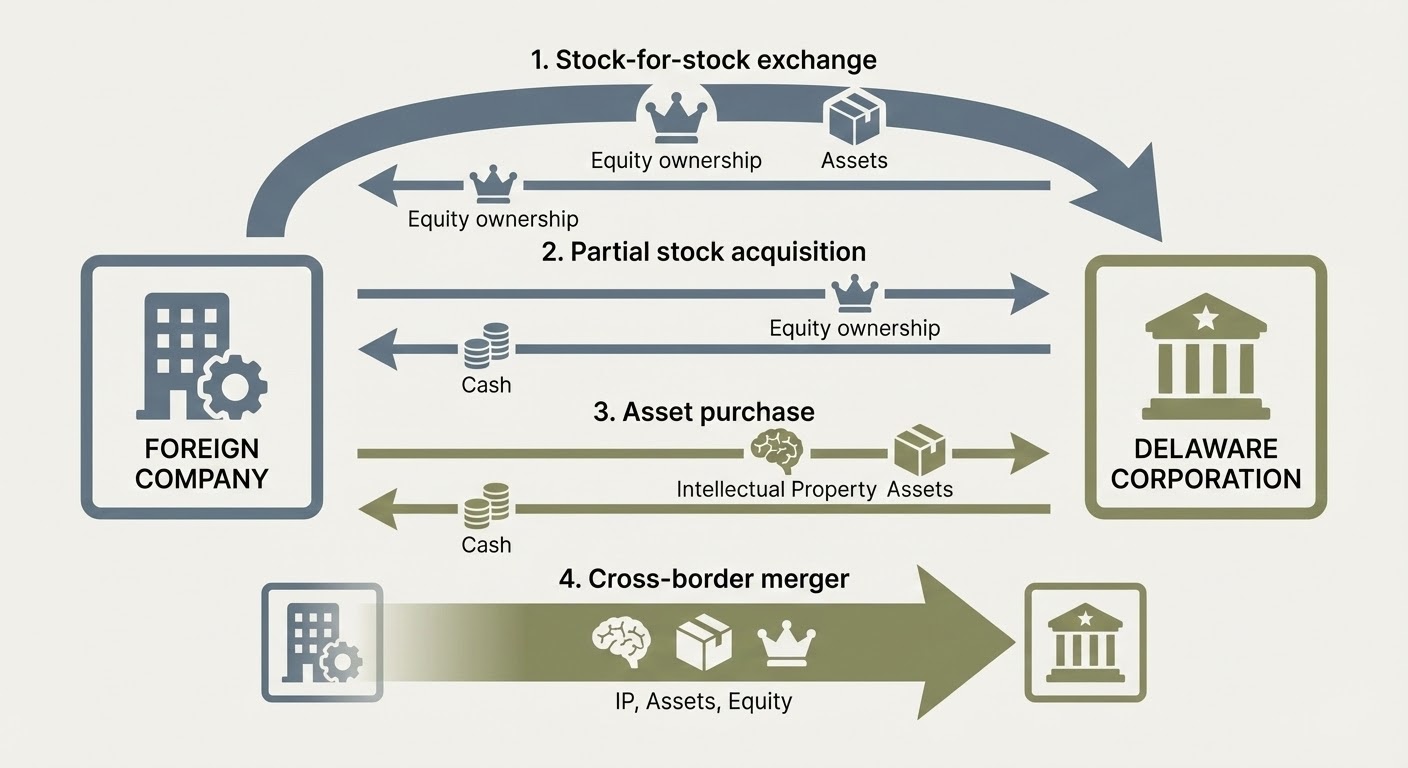
There are multiple ways to structure a flip. The most common approaches include:
Stock-for-Stock Exchange
The Delaware company owns all shares of the foreign company
Founders exchange foreign shares for Delaware shares
Partial Stock Acquisition
The Delaware company buys some of the foreign company's stock
Founders or foreign investors keep some foreign shares
Asset Purchase
The Delaware company purchases the assets and IP of the foreign company
Payment may be cash or Delaware company stock
Cross-Border Merger
The Delaware company and foreign company merge
The Delaware company survives the merger
These are not the only methods—but they are the simplest and most common.
Important: In every scenario, incorporation is only one step. Multiple additional legal transactions are required.
Choosing the Right Flip Structure
The correct approach depends on your specific facts, including:
Ownership & Stakeholders
Who owns equity in the foreign company?
Are there outside investors?
What rights do they have?
Will they continue after the flip?
Intellectual Property
Does the company own valuable IP?
What is the IP worth?
What taxes apply to transferring it?
Does IP need US registration?
Are there existing foreign registrations that require reassignment?
People & Operations
Who will continue contributing IP?
Who needs to be employed in the US?
How will incentives be structured post-flip?
Money & Taxes
Will payments continue to flow to foreign entities or individuals?
How are those payments taxed today?
How will they be taxed after the flip?
What Actually Gets Done
Once the structure is chosen, the flip is executed through a packet of legal documents, typically 10+ documents, including:
Customized Delaware incorporation documents
IP transfer or license agreements
Stock exchange or purchase agreements
Board and stockholder approvals
Ancillary compliance documents
You will usually also need:
US accountants
Foreign accountants
Sometimes tax-specialist lawyers
This is especially true where IP or prior investments exist.
What Does a Delaware Flip Cost?
Costs depend heavily on complexity, but typical drivers include:
Number of stakeholders who must consent
Type and value of assets and IP transferred
Whether a specific investor is driving the process
Whether existing accountants understand the business
Whether prior legal work introduced problems
Typical Legal Fees
Smaller specialized firms: $400–$1,000/hour
Large firms: $1,000–$3,000/hour
Total legal cost: ~$8,000–$25,000, higher for complex cases
Typical Accounting Fees
$25,000–$80,000
IP valuation is particularly expensive
Under-valuing IP can trigger severe IRS penalties
Common Founder Mistake
"We already incorporated in Delaware."
If the IP, contracts, or assets remain outside the US entity, you did not complete a flip.
FAQ
Q: Can I raise US money without flipping?
A: Sometimes, but many US investors will require a Delaware corporation that owns the core assets.
Q: Is forming a Delaware company enough?
A: No. Assets and IP usually must move as well.
Q: Do I need accountants?
A: Almost always, especially when IP or prior investment exists.
Q: Is a flip taxable?
A: It can be. That depends on structure, valuation, and jurisdictions involved.
Bottom Line
A Delaware flip is a cross-border restructuring, not a formality.
It touches equity, IP, taxes, accounting, and investor rights—simultaneously.
Need Help With Your Delaware Flip?
7 days free on any plan. No charge until you’re ready.
Get Automated Legal with Aegis
Subscribe to Aegis to build your cap table automatically — see your ownership breakdown, equity classes, and investment history organized from your documents.
We're lawyers, remember? Please read this important note:
Story LLP is a law firm, and Story's lawyers built Aegis to deliver better, standard legal services at scale so founders can choose between top-tier specialized lawyers and standardized process automations that replicate those lawyers according to their needs and budget. By definition, a standardized process may not be perfect for you. Please review our Policies page to better understand the difference, as well as how we use AI and how we manage conflicts, privilege, etc.
As a law firm, we must screen clients for conflicts of interest, and we treat all correspondence with clients seeking legal advice as privileged and confidential to the maximum extent possible in consideration of any conflicts. However, Story's law firm or our Attorney Allies do not represent you or your company as your lawyer, do not have an attorney-client relationship with you or your company, and do not provide you with legal advice absent a formal Engagement Letter signed between you and the Story LLP law firm. Please don't confuse the free knowledge we offer on this site with legal advice for you.